
TLDR: Most small creative businesses do not need a full-time SEO specialist. You can handle a lot of the basics yourself with AI, but you will still need human expertise at certain points, and pure AI content is not a magic traffic button. Use this as a decision guide so you know when DIY is enough, when to get one-off help and when ongoing SEO support is actually worth paying for.
Semrush found that purely AI-generated content took the top spot just 9% of the time, while human-written content held it 80% of the time.
Yet you keep hearing that AI means you never need SEO help, or that you must invest now or your business will suffer.
Neither is true.
This post helps you decide when DIY with AI is enough, when to get one-off help and when ongoing SEO support is worth paying for.

Do you really need an SEO specialist in the age of AI?
You probably do not need a full-time SEO specialist, but you do need some expert input at key moments.
Google’s own guidance says a small local business can probably handle much of the work itself. Hiring help can still save time and improve visibility, but choosing the wrong provider can harm your site and reputation.
Translated for you and your Showit site:
- If you are tiny, just starting and broke, you can DIY a lot with AI and basic tools.
- If your site is live, inquiries are slow or traffic is flat, you probably need at least a human checkup.
- If your business is growing and you rely on your website for leads, not investing in proper SEO at all is the expensive option.
Think of this post as a decision tree: not “should I buy SEO”, but “what is the *least* help I can get away with right now without shooting myself in the foot”.
What an SEO specialist actually does
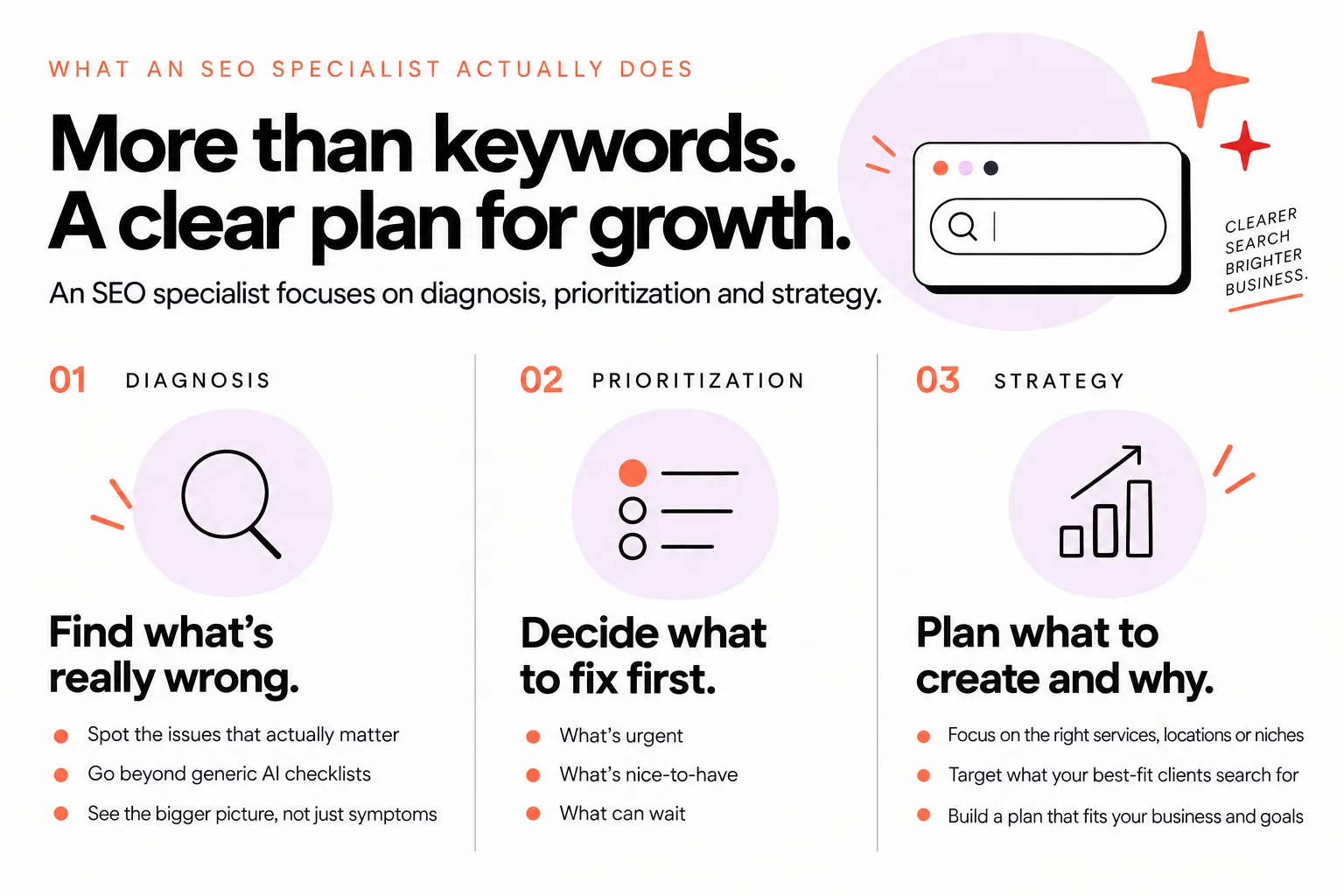
An SEO specialist is not just someone who “puts keywords on your site”.
A good one mainly does three things:
- Diagnosis: what is really wrong, and what is not
When your traffic is low, AI tools will spit out long lists:
- “Write more blog posts.”
- “Fix your meta descriptions.”
- “Add alt text.”
That is not diagnosis. That is a checklist.
Diagnosis is figuring out:
- Is Google even indexing your key pages?
- Is your website slow enough to hurt you?
- Are you targeting phrases no one actually uses?
- Are inquiries low because of traffic, or because of messaging and offers?
This is where experience matters. A specialist has seen hundreds of patterns. They can look at your site, analytics and Search Console and spot the actual problem instead of guessing.
- Prioritization: what to fix first (and what to ignore)
Your time is limited. Your energy is limited. You cannot fix everything.
AI tools love to make everything sound urgent.
A specialist helps you decide:
- Fix this broken contact page *now*.
- Update these three service pages next.
- Ignore that list of 40 technical warnings. They do not matter for your situation.
The right priorities protect you from spending five hours tweaking title tags on pages that never get searched for, while your main money page is still invisible.
- Strategy: what to create and why
AI can write infinite blog posts. That is the problem.
A specialist helps you answer:
- Who is actually searching for you?
- What do they type into Google?
- What kind of content will bring in the right people, not just any traffic?
- How do we build authority in your niche over time, so it gets easier, not harder?
This is less about rules and more about judgment.
Also, context matters. You might be:
- A newborn photographer in a small town who needs to show up for one main phrase.
- A brand designer targeting online course creators across the US.
- A wedding photographer who books through referrals first and Google second.
All three need different strategies, even if they all use Showit.
AI does not know your profit margin, your seasonality, your capacity, your local competition or your personal boundaries. A human can listen, weigh those things, then decide if you need five blogs a month or two key guides and better internal links.
So a specialist is not competing with your AI tools. They are telling you *where* to point them and what to ignore.
What AI and DIY SEO are good at, and where they break down
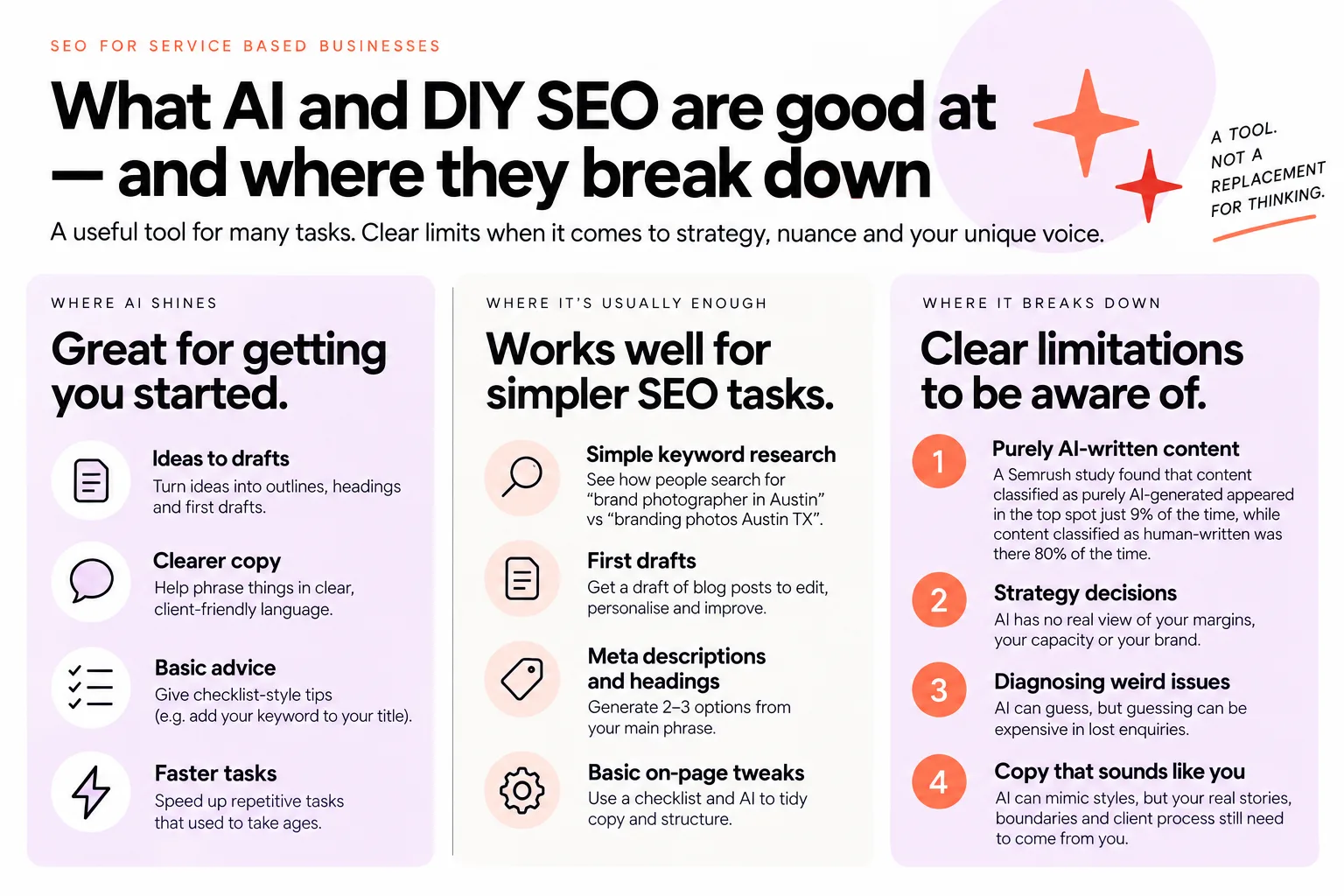
AI and beginner SEO tools are very good at some parts of SEO, and very weak at others.
Here is the honest split.
What AI is genuinely useful for
AI is great at:
- Turning your ideas into outlines.
- Spitting out headline variations.
- Helping you brainstorm keyword ideas, then you check them in a proper tool.
- Drafting a first version of a blog post or service page.
- Rewriting your own words in a clearer way.
- Helping you see gaps in your FAQs or pages.
It is like having a fast junior assistant who is never tired.
You still have to tell it what you want, check its work and decide what is actually good.
Where DIY + AI often falls apart
- Quality that looks “fine” to you, but weak to everyone else
A common issue: people use AI, read the blog it gave them and think “this sounds good”.
But they do not have the experience to see:
- It never gets specific.
- It never actually answers the searcher’s real question.
- It sounds like everyone else’s site.
- It spends 800 words saying what could be said in 200.
It is like when a non-designer looks at two logos and cannot explain why one feels “cheap”. A trained designer can.
- No real differentiation
If AI is trained on the whole internet, and every photographer feeds it “write me a blog post about what to wear for family photos”, guess what happens.
All your posts look and feel the same.
That is not great for people, and it is not great for search engines looking for helpful, original content.
- Confidently wrong instructions
AI will often tell you to do things that:
- Are technically wrong for Showit.
- Are out of date.
- Are not that important for a small site.
You need enough knowledge to spot bad advice. Without it, you waste time setting up features you do not need and miss the boring basics that move the needle.
- Weak performance of purely AI content
In one study from Semrush, content classified as purely AI-generated appeared in the top spot just 9% of the time. Content classified as human-written was there 80% of the time.
That does not mean AI content cannot rank at all. It does show there is a gap between “AI alone” and “human-created or human-reviewed” content.
- No sense of your business reality
AI does not know:
- That you only take 10 weddings a year and are booked on certain dates.
- That your dream clients are LGBTQ+ couples, not “all brides”.
- That you cannot travel every weekend because of kids.
It can’t protect you from attracting work you hate. It can’t remind you that ranking for a huge national term might not actually be useful right now.
This is why I like AI best as a drafting and brainstorming tool, not as a “set and forget” SEO machine.
What parts of SEO should you use AI for? (and what to keep human)
Let’s make this very practical for where you are now.
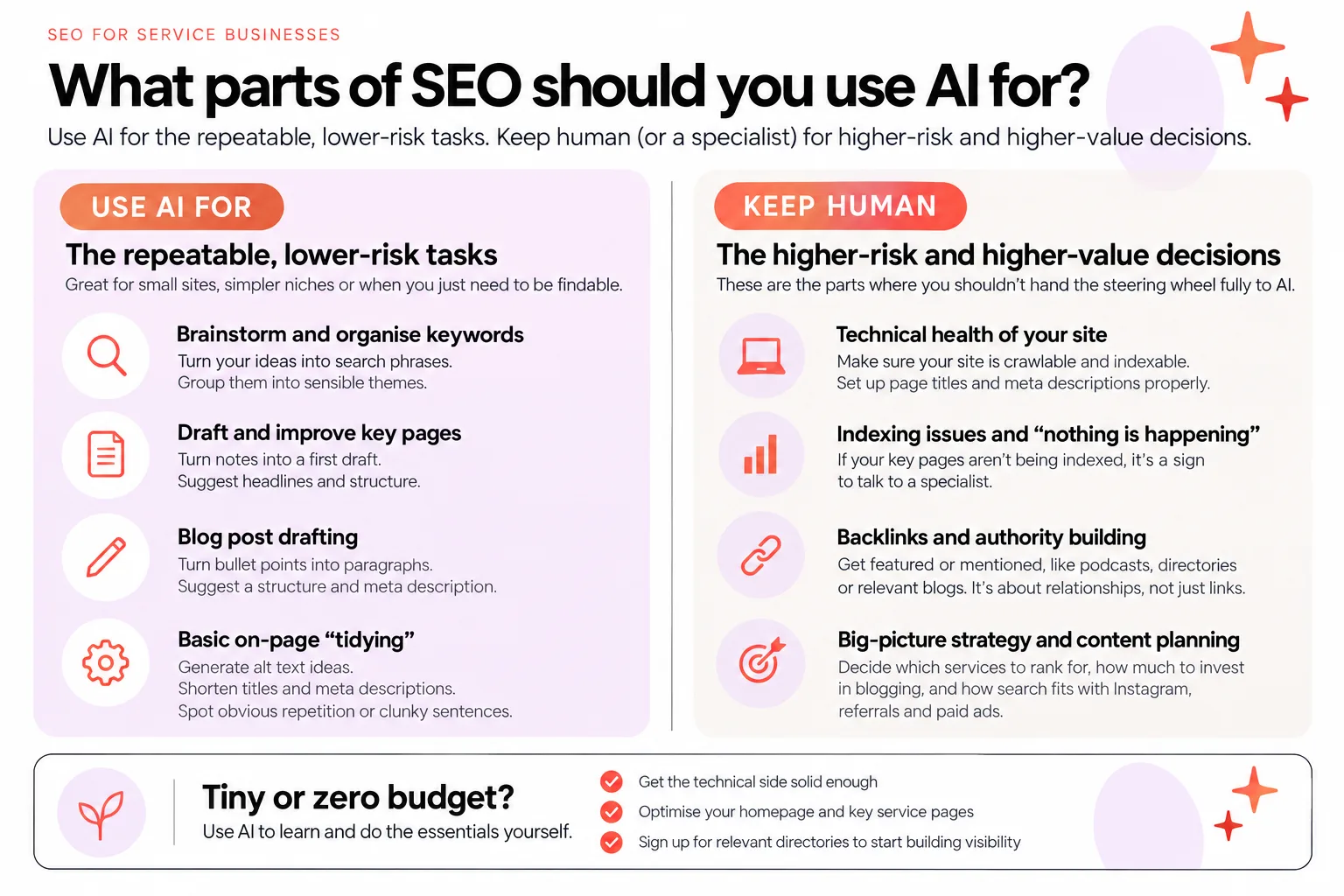
If you have absolutely no budget and are a tiny, just-starting-out business, you generally do not need to hire an SEO specialist yet. Use AI tools to help you DIY.
Every website should be doing at least a basic level of SEO, and AI has improved to the point where you can get a much better baseline level with its help than before.
Here is how I would split the work.
Use AI + DIY for these parts
If your site is small, your niche is not hyper-competitive, you have essentially no marketing budget yet and you just need to be findable for a handful of clear services in your local or niche market, AI + DIY is usually enough for:
- Basic keyword research
Use beginner-friendly tools (you can explore some ideas from guides on the best SEO tools for small businesses) and AI to brainstorm what people might search. Then pick simple, obvious phrases tied to your actual services and location.
- On-page SEO for your main pages
With AI’s help, you can:
- Write clear, keyword-informed page titles and meta descriptions.
- Structure each page with one main heading and simple subheadings.
- Work your target phrases into headings and body copy in a natural way.
- Blog post outlines and drafts
Use AI to:
- Turn your topic list into outlines.
- Draft first versions from bullet notes or voice memos.
- Suggest FAQs and headings.
Then you come in and:
- Add your stories, examples and opinions.
- Make it specific to your audience and offers.
- Cut fluff and generic lines.
- Simple technical checks
At the start, focus your energy on:
- Making sure Google can access and index your site.
- Fixing obvious broken links and 404s.
- Checking that your Showit site works well on mobile.
- Directories and citations
Directories are really underrated. If you have no money coming in, prioritize:
- Getting your technical basics right.
- Doing on-page SEO on your homepage and main pages.
- Signing up for relevant directories, including places your ideal clients actually search.
- Understanding what backlinks are and why they matter for getting your brand featured and found.
Appearing on podcasts or in other people’s content is a useful way to build backlinks and get your brand out there when you are starting out.
This alone puts you ahead of a lot of creatives who never touch their SEO.
Keep these parts human (at least partly)
Even if you use AI, some things really benefit from human oversight:
- Technical setup and indexing for key pages
You do not need to worry if low-value pages like tags or categories are not indexed. That is normal.
But if your key service or sales pages are missing from the index, or Google is not picking up your Showit pages the way you expect, it may be time to talk to a specialist to avoid deeper issues.
- Prioritizing tasks when your time is tight
If you are juggling shoots, edits and admin, you need to know:
- Which 3 tasks this month matter most.
- Which 20 tasks can wait.
This type of ruthless prioritization usually comes from experience, not from AI task lists.
- Content strategy and positioning
Because AI has raised the baseline and made content creation faster for everyone, every niche is now more competitive. You want to be the one moving ahead by combining AI with human strategy and quality control, not falling behind.
That human piece can be:
- You, after learning the basics properly.
- An SEO specialist giving you a plan during a coaching call.
- A done-for-you blogging service that includes human review.
- Improving weak-but-not-obviously-bad content
As covered above, early AI posts often seem fine to a beginner but look obviously weak to an experienced SEO.
If you have already written a bunch of posts with AI and nothing is really happening, that is usually a sign to get a human to audit or coach you, not just write more of the same.
- When you start investing real money in traffic
If you have some marketing budget, hiring an SEO specialist is like going to a medical specialist. It makes sense to invest when you can, because they can really help you grow faster and avoid mistakes.
If your budget is low, investing in some targeted SEO coaching can massively improve the results you get from DIY and AI, even if you cannot afford ongoing custom SEO work yet.
If you want a deep dive into how AI and search are evolving, there is also a breakdown of how AI search is changing SEO, which can help you set realistic expectations.
Signs you actually need an SEO specialist
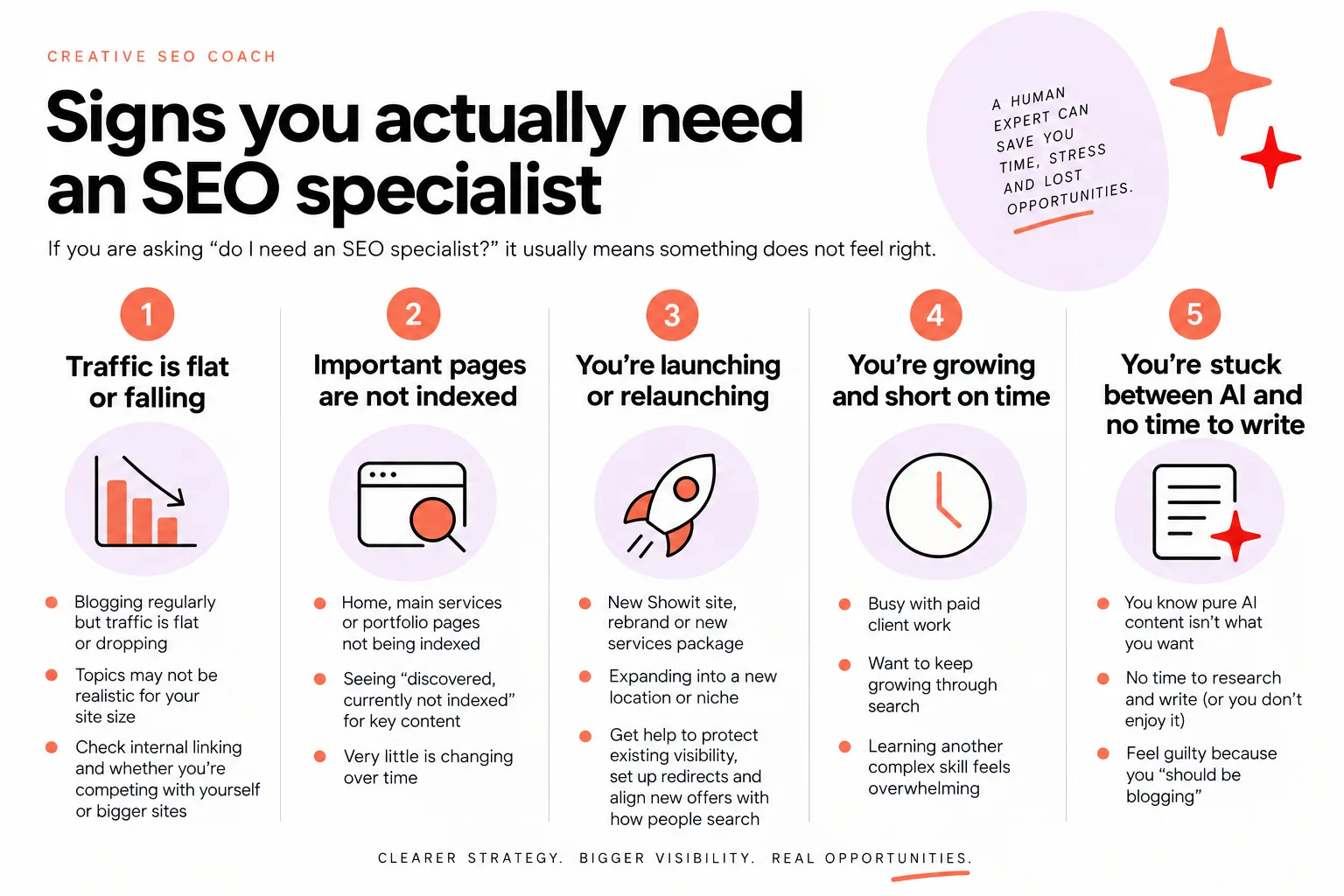
Let’s talk about the red flags where “I’ll just ask AI again” stops being sensible and starts costing you.
If you recognize yourself in any of these, a specialist’s eyes on your site is often the smarter, cheaper next step.
- Flat or falling organic traffic, despite regular content
You are:
- Blogging consistently.
- Updating your portfolio.
- Posting on social.
But your search traffic is flat or down.
You have already tried following AI advice, tweaked meta descriptions, maybe changed some headings and nothing changes.
This is a classic “diagnosis” moment. You need someone to look under the hood, check your analytics and Search Console and tell you what is actually wrong.
- Your key pages are not showing up at all
You type your brand name + service into Google, and:
- Your homepage appears, but your main services do not.
- Or random minor pages show up, but not the one you actually want people to land on.
You do not need to panic if unimportant pages are missing. You do need help if your offers are invisible.
- You are about to redesign or migrate your Showit site
Site launches, rebrands and platform moves are key risk moments.
Launch without redirects or proper planning and you can:
- Lose rankings you already had.
- Break URLs people have saved.
- Confuse search engines about which version of a page to keep.
Having an SEO person check your plan and your new Showit structure before and after launch can save you months of recovery.
- You are getting traffic, but inquiries are not right
Maybe you rank for something, but:
- The wrong people keep inquiring.
- Budgets are tiny.
- The projects are not your style.
This usually needs a mix of SEO and messaging work. AI can write more words, but it cannot see misalignment between who you attract and what you offer.
- You are about to invest more in marketing
You are planning to:
- Start running ads.
- Join paid directories.
- Invest in branding or a new site.
That is exactly when you want your site to be findable and clear. Otherwise, you pay to send people to a site that leaks inquiries.
A one-off website review or coaching call at this stage can be a very efficient use of budget.
If you want that kind of focused support, you can book a one-hour SEO coaching call and walk away with a concrete plan instead of more generic tips.
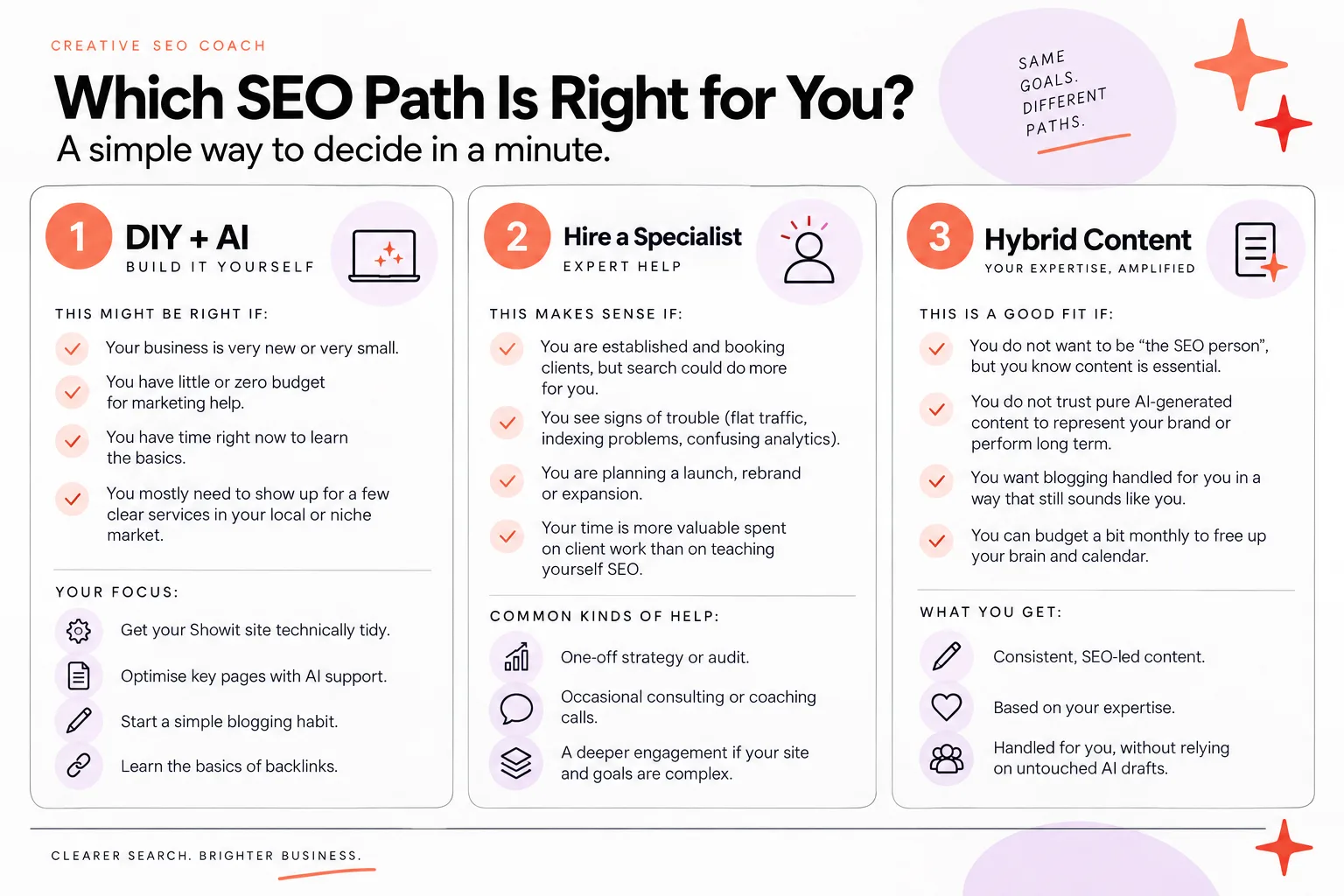
A simple decision framework: DIY, specialist, or hybrid?
Now let’s turn all of that into something you can actually act on.
Read through these three paths and pick the one that sounds most like where you are now.
Path 1: DIY + AI
This is likely your best fit if:
- You are in your first year or two of business.
- You have little or no marketing budget.
- Your site is small (a handful of main pages).
- You just need to be findable for clear, local services.
- You are willing to learn a bit and actually do the work.
Your focus:
- Get your Showit site technically sound enough.
- Optimize your homepage and main service pages.
- Start a simple blog with AI-assisted drafts and human editing from you.
- Build some basic backlinks through directories, collaborations and features.
You will move slower than with expert help, but you also avoid spending money before you are ready.
Path 2: Specialist
This is likely the smarter route if:
- Your business is established or growing.
- You already get clients from your site and want more.
- Your niche is competitive, or you target a wider area than just your town.
- You have hit a plateau or seen a drop in search traffic.
- You are planning a major change like a rebrand, migration or big new offer.
Your focus:
- Get a proper audit or coaching session to diagnose what is really going on.
- Prioritize a short list of high-impact fixes and projects.
- Use AI as a helper, guided by a human strategy.
You might not need a long-term retainer. Sometimes a few targeted sessions plus some done-for-you fixes are enough to change your trajectory.
Path 3: Hybrid human-reviewed content
This fits if:
- You know content is your bottleneck.
- You do not want to become an SEO expert.
- Pure DIY AI posts feel generic or overwhelming.
- You have some budget and want consistent, strategic blogging, but not a full custom SEO campaign.
Here, the goal is to combine:
- AI for speed.
- Human SEO expertise for topic planning and quality control.
That is where something like Fasta Blogging comes in, which we will talk about next.
Where Fasta Blogging fits: a human-reviewed content engine instead of a full SEO hire
For a lot of creative businesses, the real problem is not “do I need an SEO specialist” but “I will never keep up with blogging on my own”.
Fasta Blogging is built as that middle ground.
Here is what it actually is and does:
- Fasta Blogging is a done-for-you blogging service built to bring clients to your website without adding to your workload.
- Every post is built from your expertise, drafted with AI and reviewed by a human SEO specialist before it reaches you.
- It delivers four SEO-led blog posts every month.
So instead of you:
- Spending weekends trying to outline posts.
- Second guessing if your topics are even worth writing.
- Publishing one post, then ghosting your blog for six months.
You get:
- Topics planned around your own keywords, audience and services.
- Posts that are aligned with how people actually search for what you offer.
- Content that uses AI for speed but is edited and guided by someone who understands search.
This is not a full SEO strategy service. It is a content engine that sits in the middle:
- More strategic and consistent than pure DIY.
- Much lighter and cheaper than hiring a specialist to build custom posts from scratch.
If that sounds like the gap you are in, you can check out the details at Fasta Blogging.
Other ways to get human SEO help without a full retainer
If a monthly service is not what you want, there are still low-commitment ways to get a human brain on your site.
Here are two simple options that work well for creatives:
- Short, focused coaching calls
A one-hour coaching call can be used to:
- Review your Showit site and point out the main problems.
- Walk you through your analytics or Search Console.
- Help you choose keywords and topics that suit your services and location.
- Build a 90-day action plan you can go and implement with AI’s help.
For example, with a $250 one-hour coaching call, clients typically walk away with a much better understanding of what they are doing, and a clear list of priorities.
You keep doing your own SEO, but you stop guessing.
- One-off site audits
A simple audit gives you:
- A clear, human explanation of what is going on technically and strategically.
- A prioritized list of changes.
- Clarity on which issues matter for a small Showit site, and which are noise.
If you want a quick reality check like that, a free video website audit is a good way to see where you stand before deciding how much help you actually need.
These kinds of touchpoints are often the best use of budget for small creative businesses: you get direction and clarity, then use AI and your own time to implement.
FAQ: common worries about hiring SEO help vs. relying on AI
How do I avoid wasting money on a bad SEO provider?
You are right to be cautious. Google itself warns that choosing the wrong provider can harm your site and reputation, even though a good one can save time and improve visibility.
High-level vetting tips:
- They should be able to explain what they do in plain language.
- They should not promise “number 1 rankings” or instant results.
- They should focus on your business goals, not just vague traffic.
- They should be open about what work is one-off and what is ongoing.
- They should be fine with you keeping control of your logins and accounts.
You can also cross-check what they say against Google’s own advice in places like Google Search documentation if you want a sanity check.
Has AI made SEO specialists obsolete?
No.
AI has made some tasks faster. It has raised the baseline quality for people who had no idea where to start. That is a good thing.
But you still need:
- Strategy: deciding what to write and why.
- Judgment: knowing which advice to act on and which to ignore.
- Quality control: editing AI drafts into something genuinely useful and specific.
If you want to go deeper into the relationship between AI content and search, there is also a post on whether AI-generated content is going to hurt your SEO that breaks down the nuances.
The sweet spot is usually AI plus human expertise, not one or the other.
When should I actually start doing SEO?
Every site should have at least a basic level of SEO from the start. That means:
- Clear page titles and headings.
- Simple, descriptive URLs.
- Making sure your key pages can be indexed.
- Some basic keyword thinking when you write your copy.
You do not need a full specialist from day one, but you do want to avoid building a beautiful Showit site with big, simple mistakes baked in.
As soon as you are serious about getting leads through your site, it is worth:
- Doing at least a one-off audit or coaching call, or
- Using a hybrid service to keep your blog active with search-friendly content.
How long does SEO take, with or without AI?
SEO is still a medium- to long-term channel, whoever does the work.
AI can speed up how fast you produce content or implement changes, but it cannot speed up how fast search engines:
- Discover your pages.
- Re-evaluate your site.
- Build trust in your content.
You might see some early changes within weeks on a small site. Bigger gains usually take months.
That is why I recommend treating SEO like you treat strength training:
- Do the basics consistently.
- Increase the intensity when you have capacity or budget.
- Use specialists for form checks so you do not injure your site.
If you want a clear, human look at your current Showit site so you know whether DIY, a specialist or a hybrid makes sense, you can request a short Free Video Website Audit and use it as your starting point.


