
TL;DR
AI search is changing SEO because people no longer need to click through to a website to get answers, compare options or make buying decisions.
Google AI Overviews, AI Mode, ChatGPT, Gemini, Perplexity and other AI search tools can now summarise information, recommend brands, compare products and help users make decisions directly inside the search experience.
SEO is not dead. It is expanding.
To stay visible, businesses need to focus on traditional SEO, GEO and AEO. That means creating clear answers, building trust across the wider web, earning third-party mentions, publishing original research, creating comparison content and making your website easy for search and AI to understand.
Traffic may drop, but revenue can still grow if the visitors who do arrive are more informed, more trusting and closer to buying.
The goal is no longer just to rank.
The goal is to become the trusted answer.
The new era of AI search
Search is changing faster than it has in years.
For a long time, SEO was mostly about ranking on Google, getting clicks and driving traffic to your website.
That still matters.
But it is no longer the whole story.
Google AI Overviews, Google AI Mode, ChatGPT, Gemini, Perplexity and other AI search tools are changing how people discover, compare and choose businesses.
Instead of searching Google, clicking five websites, reading reviews and narrowing down options manually, users can now ask an AI tool to do a lot of that work for them.
They can ask:
“What is the best SEO tool for Showit websites?”
“Which photographer should I hire in Sydney?”
“What is the best CRM for a small creative business?”
“Compare X vs Y.”
“What are the best alternatives to this product?”
The AI tool can then summarise information, compare options, mention brands and recommend solutions before the user ever visits a website.
That is the shift.
Your website may still influence the decision.
But it may not always get the click.

SEO is becoming bigger than Google
For a long time, SEO had one main job: help your website show up when someone searched on Google.
That job still matters.
But it is no longer enough.
People are now discovering businesses through ChatGPT, Gemini, Perplexity, Google AI Overviews, Reddit, YouTube, TikTok, review sites and comparison content.
That means your visibility is no longer controlled by one search box.
It is shaped by the entire web.
This is where GEO and AEO become important.
GEO, or Generative Engine Optimisation, is about helping your brand appear in AI-generated answers. When someone asks ChatGPT or Gemini for recommendations, comparisons or advice, GEO is the work that increases your chances of being mentioned.
AEO, or Answer Engine Optimisation, is about making your content easy to understand, summarise and repeat. It means answering questions clearly, structuring pages well and making sure your expertise is obvious.
Traditional SEO helps search engines find and rank your website.
GEO and AEO help AI tools understand, trust and recommend your brand.
So SEO is not disappearing.
It is becoming a wider visibility strategy.
From search engines to search agents
According to the 2026 Imperva Bad Bot Report, automated bot traffic now accounts for more than 53% of all web traffic, meaning human visitors are no longer the majority online.
That matters because the internet is no longer just built around humans clicking links. AI crawlers, bots and automated agents are now a major part of how content is discovered, read and processed.
So if your website is not clear, structured and easy for machines to understand, you are not just creating a worse experience for users. You are making it harder for the systems that influence search and AI visibility to understand your business.
In the past, someone would search a keyword, scan the results, open a few websites and piece the answer together themselves.
Now, AI search tools can do much more of that work for them.
They can compare options, summarise reviews, explain pros and cons, answer follow-up questions and help the user decide what to do next.
That means search is moving from “show me websites” to “help me make a decision.”
This is a big shift for business owners.
Your website is no longer just competing for a click. Your business is competing to be understood well enough that an AI tool can confidently recommend you.
For example, someone might not search:
“SEO consultant near me”
They might ask:
“Who is the best SEO consultant for a Showit website?”
Or:
“Compare the best SEO tools for creative business owners.”
Or:
“What website platform should I use if I care about design and SEO?”
In those moments, the AI tool is not just looking for a page that mentions the keyword. It is trying to understand the full picture.
It needs to know:
☐ Who you are.
☐ What you do.
☐ Who you help.
☐ What you are known for.
☐ What makes you different.
☐ Why you should be trusted.
☐ How you compare to other options.
☐ Whether other people are saying the same thing about you.
This is why clear positioning matters more than ever.
If your website is vague, AI will struggle to explain your business.
If your services are unclear, AI will struggle to recommend you for the right searches.
If your brand is only mentioned on your own website, AI has fewer trust signals to work with.
But if your website clearly explains what you do, your content answers real buying questions and your brand is mentioned across reviews, articles, podcasts, directories and social platforms, AI has a much stronger understanding of where you fit.
That is the new job of SEO.
Not just ranking pages.
Building a brand that search and AI can understand, trust and recommend.
If AI cannot clearly answer “why this business?” it is less likely to include you in the shortlist.
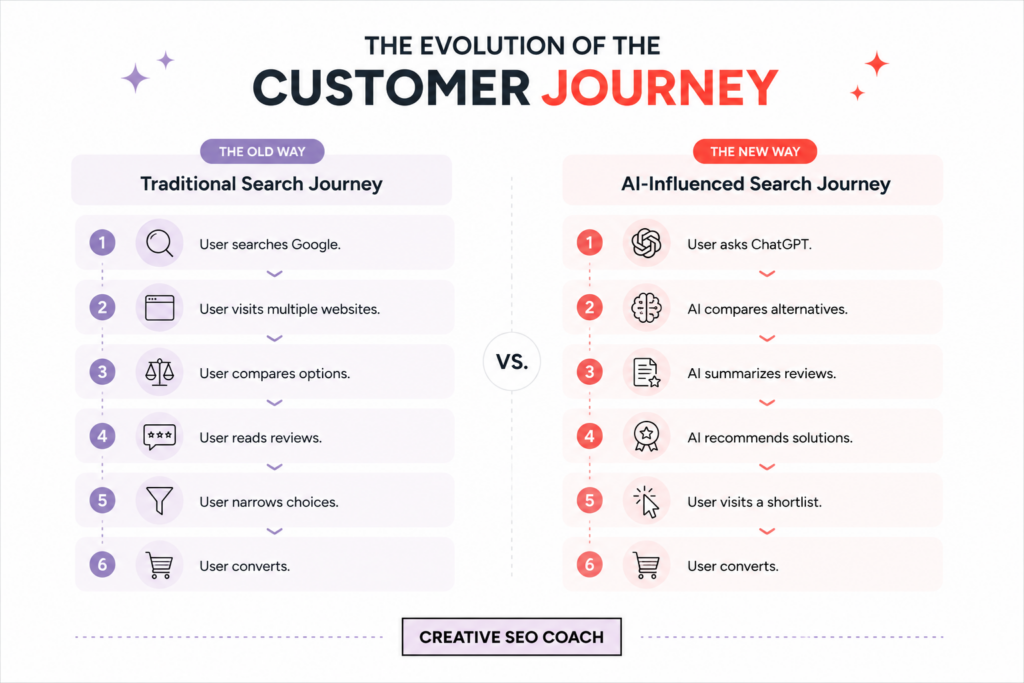
The Customer Journey Has Changed
One of the biggest fears around AI search is losing traffic.
And yes, some websites may see fewer clicks.
If an AI Overview answers the question directly, fewer users may need to click through to a website.
But that does not always mean fewer sales.
In many cases, the traffic that does arrive may be more valuable.
Here is the old search journey:
- User searches Google.
- User clicks several websites.
- User compares options.
- User reads reviews.
- User narrows the list.
- User eventually converts.
Now, the AI-influenced journey can look more like this:
- User asks ChatGPT, Gemini or Google AI Mode.
- AI compares options.
- AI summarises reviews.
- AI recommends a shortlist.
- User searches your brand.
- User visits your website.
- User converts.
The research process has not disappeared.
It has moved.
By the time someone lands on your website, they may already understand the problem, know the options and trust your brand more than a cold visitor would.
That means fewer clicks can still lead to better leads.
The question is not only “How much traffic did we get?”
The better question is:
“Did the right people find us, trust us and buy from us?”

The 4 strategies businesses need for AI search
To win in the AI search era, businesses need to focus on four key areas.
1. Create bottom-funnel content
AI search tools are often used when people are close to making a decision.
They are not only asking basic questions.
They are asking comparison questions, pricing questions, alternative questions and “best option” questions.
That means bottom-funnel content is more important than ever.
This includes:
☐ Comparison pages.
☐ Alternatives pages.
☐ Best tools or best service lists.
☐ Pricing guides.
☐ Case studies.
☐ Buying guides.
☐ ROI content.
☐ Implementation guides.
☐ “Which option is right for me?” content.
For example, if you sell wigs, do not only write “What is a wig?”
Write:
☐ Best wigs for thinning hair.
☐ Lace wigs vs traditional wigs.
☐ Best wig styles for hair loss.
☐ How much does a high-quality wig cost?
☐ Human hair wigs vs synthetic wigs.
This is the content people look for when they are closer to buying.
It is also the type of content AI tools can use when making recommendations.
2. Build your brand beyond your website
In the old SEO world, your website was the main focus.
In the AI search world, your website is only one part of your online reputation.
AI tools look across the wider web to understand whether your brand is trustworthy.
That means your business needs to show up in more places than your own website.
You want to build visibility through:
☐ Industry publications.
☐ Guest articles.
☐ Podcast interviews.
☐ YouTube videos.
☐ Reddit discussions.
☐ Customer reviews.
☐ Social media content.
☐ Comparison sites.
☐ Directories.
☐ Third-party mentions.
This matters because AI tools often trust what others say about you more than what you say about yourself.
If your brand only exists on your own website, you are making it harder for AI to understand who you are and why you matter.
3. Publish original research and data
AI can generate generic content instantly.
That means generic content is becoming less valuable.
If your article says the same thing as every other article, there is no strong reason for AI to reference you.
Original research is different.
If you publish information nobody else has, your website becomes the source.
This could include:
☐ Industry surveys.
☐ Customer data.
☐ Benchmark reports.
☐ Trend reports.
☐ Case studies.
☐ Internal data analysis.
☐ Expert interviews.
☐ Original frameworks.
For example:
“We analysed 500 Showit websites and found the most common SEO issues.”
That is far more valuable than:
“10 SEO tips for your website.”
Why?
Because it gives search and AI something unique to reference.
The future of content is not just publishing more.
It is publishing what only your business can publish.
4. Make your website easy for AI to understand
AI visibility does not only happen off your website.
Your website still matters.
A lot.
But your content needs to be clear, structured and easy to extract.
That means using:
☐ Clear headings.
☐ Direct answers.
☐ FAQ sections.
☐ Schema markup.
☐ Internal links.
☐ Comparison tables.
☐ Short summaries.
☐ Helpful examples.
☐ Strong page titles.
☐ Clear service descriptions.
Do not bury the answer halfway down the page.
Start with the answer.
Then explain.
AI tools need clarity.
So do humans.
What businesses should measure now
Rankings and traffic still matter.
But they no longer tell the full story.
In the AI search era, businesses should also track:
1. Brand search growth
Are more people searching for your business by name?
This can be a sign that people are discovering you elsewhere, including AI tools, podcasts, reviews, social media or third-party content.
2. Assisted conversions
The customer journey is no longer linear.
Someone may discover you in ChatGPT, validate you on Reddit, search your brand on Google, visit your website and then convert.
The last click does not tell the whole story.
3. Conversion rate by source
AI-influenced visitors may arrive with stronger intent.
Compare how different sources convert, not just how much traffic they send.
4. Sales qualified leads
Traffic is not the goal.
Revenue is.
A smaller number of better-fit leads is more valuable than a large number of visitors who never buy.
5. Sales cycle length
If people arrive more educated, they may make decisions faster.
That is worth tracking.
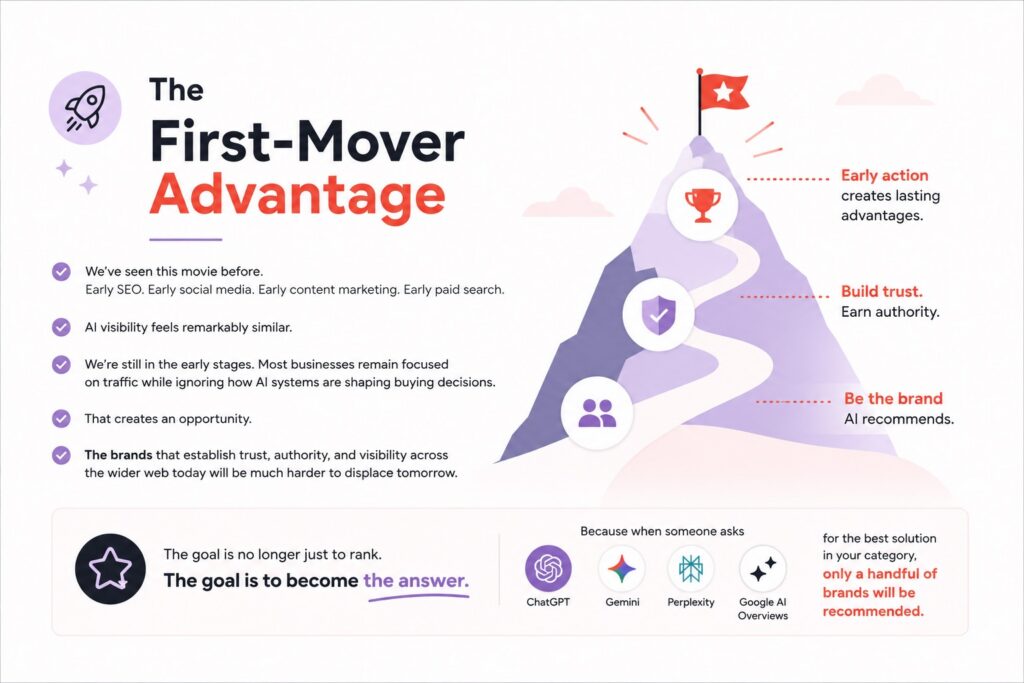
The brands that become known now will be harder to replace later
AI search is changing the order of discovery.
In the old search journey, people found your website first, then decided whether to trust you.
Now, AI tools may decide whether you are worth mentioning before someone ever lands on your site.
That makes trust the real asset.
If ChatGPT, Gemini, Perplexity or Google AI is comparing options in your category, it will not recommend every business. It will choose the brands it can understand, verify and confidently explain.
That is why this moment matters.
Most businesses are still treating SEO like a traffic game. They are watching rankings, clicks and sessions while missing the bigger shift happening underneath.
The opportunity is to build the signals AI tools need before your competitors catch up.
Clear content.
Original insights.
Strong reviews.
Third-party mentions.
Consistent brand presence.
Helpful answers.
The more visible and trusted your brand becomes across the wider web, the easier it is for AI systems to connect you with the right searches.
The goal is not just to get found.
The goal is to be understood, trusted and recommended.
Conclusion
AI search is not the end of SEO.
It is the next stage of it.
For years, marketers focused on rankings, clicks and traffic. Those metrics still matter, but they no longer show the full picture.
A buyer can now discover your brand inside an AI answer, compare you against competitors, read summarised reviews and arrive on your website already closer to making a decision.
That means your job is not just to win the click.
Your job is to build enough trust that AI tools understand, reference and recommend your brand.
To do that, you need clear content, strong answers, original research, third-party visibility, customer reviews, expert-led insights and a website that is easy for search and AI to read.
SEO is getting bigger, not smaller.
The brands that adapt now will have the advantage later.
FAQs
Is SEO dead because of AI search?
No, SEO is not dead.
SEO is changing. Traditional rankings still matter, but businesses now also need to think about how AI tools like ChatGPT, Gemini, Perplexity and Google AI Overviews find, understand and recommend brands.
What is AI search?
AI search is a search experience where artificial intelligence helps answer questions, compare options, summarise information and recommend solutions.
Instead of only showing a list of links, AI search tools can give users a more direct answer.
What is GEO?
GEO stands for Generative Engine Optimisation.
It is the process of improving your chances of being mentioned or referenced by generative AI tools like ChatGPT, Gemini and Perplexity.
What is AEO?
AEO stands for Answer Engine Optimisation.
It is the process of structuring your content so search engines and AI tools can easily understand and repeat your answers.
How is AI search different from traditional Google search?
Traditional Google search usually gives users a list of results to click.
AI search can summarise the answer, compare options and recommend brands directly inside the search experience.
This means users may make decisions before they ever visit a website.
Will AI search reduce website traffic?
For some websites, yes.
AI search can reduce clicks because users may get answers directly inside Google, ChatGPT or another AI tool.
But traffic quality may improve if the people who do click are more informed and closer to buying.
How do I get my brand mentioned in AI search?
To increase your chances of being mentioned in AI search, create clear answer-led content, publish comparison pages, earn third-party mentions, collect detailed reviews, show up in trusted industry sources and publish original research or data.
What type of content works best for AI search?
The best content for AI search includes:
☐ Comparison content.
☐ Alternatives pages.
☐ FAQs.
☐ Original research.
☐ Case studies.
☐ Reviews.
☐ Buying guides.
☐ Decision-stage content.
AI tools need clear, trustworthy information they can understand and summarise.
Why do third-party mentions matter for AI search?
Third-party mentions help AI tools understand that your brand is trusted beyond your own website.
Mentions in reviews, podcasts, Reddit discussions, industry publications, directories and comparison articles can all support your authority.
What should I track instead of just traffic?
Track brand search growth, assisted conversions, conversion rate by source, sales qualified leads, revenue and sales cycle length.
Traffic still matters, but it is not the only measure of success in the AI search era.


