
TL;DR
• What It Is query fanout: When you ask an AI (like ChatGPT or Google Gemini) a complex question, it doesn’t just run one search. It breaks your prompt into multiple, specific sub-queries—known as “Query Fanouts”—to gather comprehensive data before answering you,.
• How Query fanout Works: The AI acts like a researcher, adding high-intent keywords like “best,” “reviews,” “top,” or the current year (e.g., “2025”) to find the most specific and relevant facts.
• Why query fanout Matters: Ranking for the user’s original question is no longer enough. If your content doesn’t provide answers to the specific background questions the AI is secretly asking, you will be invisible in the final result.
• How to optimize for query fanout:
◦ Build Topic Clusters: Create groups of interlinked pages that cover every angle of a subject.
◦ Write for AI: Use clear headings, short “chunks” of text, and direct definitions so machines can easily process your content.
◦ Use Schema Markup: Label your data (like prices and ratings) in the code so the AI can instantly extract it
Introduction: What is Query Fanout?
Have you ever wondered what actually happens when you ask an AI like ChatGPT or Google Gemini a complex question? You might think the AI simply looks into its memory to give you an answer. But in 2025, that is rarely the case.
Instead, the AI acts like a research assistant. It takes your single question, breaks it down into several specific searches, gathers the data, and then synthesizes an answer. This process is called Query Fanout, and if you want your content to be found today, you need to understand how it works.
What is Query Fanout?
Query fanout is the “under the hood” process used by Answer Engines (like Claude, ChatGPT, and Google AI Mode) to improve the quality of their responses.
Because users often ask broad or vague questions, the AI cannot rely on a single search to provide a good answer. Instead, the system “fans out” the user’s prompt, splitting it into multiple, high-intent sub-queries. It runs these searches simultaneously to gather specific information before merging the results into a single, comprehensive response.
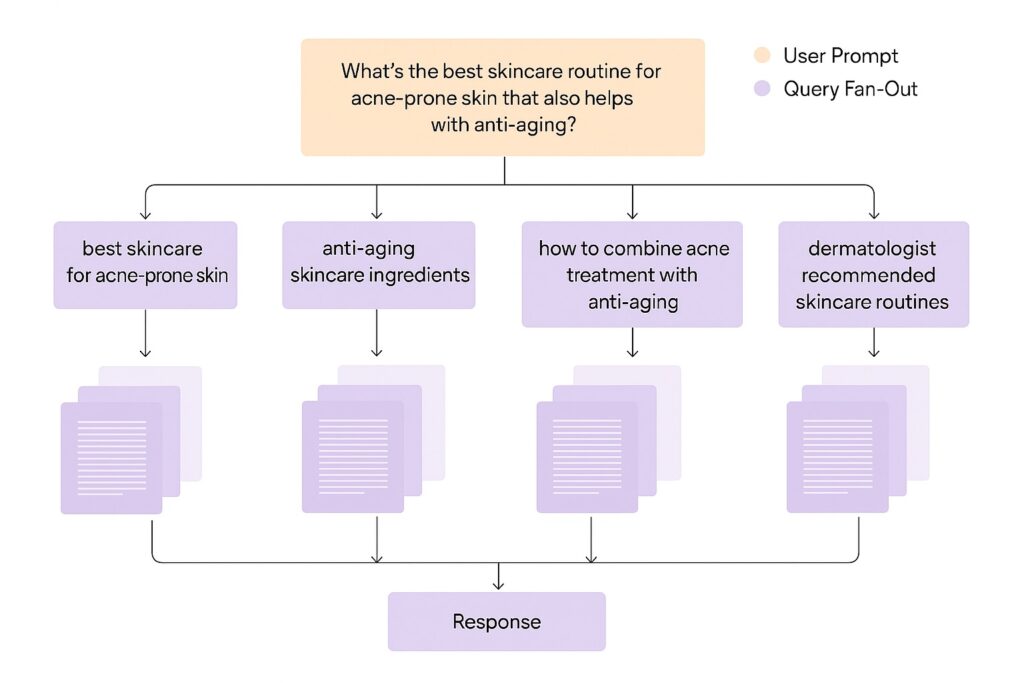
How It Works: A Real-World Example
To understand how this works, let’s look at the example shown above.
Imagine a user asks an AI:
“What’s the best skincare routine for acne-prone skin that also helps with anti-aging?”
To an Answer Engine, that single question is not enough on its own. To produce a genuinely helpful response, the model breaks the prompt into multiple focused sub-queries, often called a query fan-out.
Those queries might look like this:
• “best skincare for acne-prone skin”
• “anti-aging skincare ingredients”
• “how to combine acne treatment with anti-aging”
• “dermatologist recommended skincare routines”
Each of these queries targets a different angle of the original question. One focuses on acne, another on aging, another on ingredient compatibility, and another on expert validation.
During this process, the AI often adds intent-refining keywords such as “best,” “recommended,” or “ingredients” to improve accuracy and usefulness. This helps the model pull from authoritative, comparative, and instructional sources rather than surface-level content.
Google uses this same approach in its AI Mode. When it detects a question that requires deeper reasoning, it automatically decomposes the query into subtopics and runs multiple searches behind the scenes. The final answer is then synthesized from all of those results, rather than pulled from a single page or keyword match.
Why Does This Matter?
Here is the uncomfortable truth: You might rank for the user’s original question, but if you don’t rank for the fanout queries, you are invisible.
In the past, you only had to worry about matching the user’s search phrase. Now, you have to worry about the queries the AI generates to do its research. If your content doesn’t answer those specific sub-queries (like “reviews” or “comparisons”), the AI won’t pull your information into its final answer.
By optimizing for query fanout, you increase your chances of earning AI mentions (where the AI names your brand) and AI citations (where it links to your content as a source).

How to Optimize Your Content for Query Fanouts
Since AI systems process information differently than humans, you need to structure your content so machines can easily “read” and extract it. Here are four strategies to get started:
1. Create “Topic Clusters” Don’t just write one broad article. Create a group of interlinked pages that cover a topic comprehensively. You should have a central “pillar page” for the main topic and “cluster pages” for specific subtopics. This increases the odds that you will have an answer for the various sub-queries the AI generates.
2. Write for “NLP” (Natural Language Processing) AI models love structure. To make your content friendly to Natural Language Processing:
• Write in Chunks: Use self-contained sections that answer specific questions.
• Provide Definitions: When introducing a concept, define it clearly and directly.
• Use Clear Headings: Use descriptive subheaders so the AI can quickly identify what each section is about.
3. Answer the “Fanout” Questions Research the specific questions people ask about your industry. Break your main topic down into specific sub-intents (like pricing, comparisons, or specific features) and address them in subsections. If you answer the specific, high-intent questions the AI is searching for, you become the expert it relies on.
4. Use Schema Markup This is a technical label you add to your website code that tells the AI exactly what your data is (e.g., labeling a price as a price, or a rating as a rating). This makes it much easier for the system to extract facts to answer product-related queries.
To learn more about ranking for in AI Results. Check out our article How to Transform SEO into AI SEO.
The Bottom Line: What is Query fanout?
Think of an AI Answer Engine like a very diligent college student writing a research paper. If you ask them a question, they aren’t just going to guess; they are going to go to the library and look up five or six different books to find the facts. Query Fanout is that trip to the library. If your content doesn’t appear in those specific books they pull from the shelf, you won’t make it into the final paper.
Frequently Asked Questions
Q: What exactly is a “Query Fanout”?
A: Query fanout is a process used by AI search systems (like ChatGPT, Claude, and Google AI Mode) to answer complex questions. Instead of running just one search based on what you typed, the AI “fans out” your prompt, splitting it into multiple, specific sub-queries. It gathers information for all these sub-queries and merges the results into a single, comprehensive answer.
Q: Why doesn’t the AI just search for exactly what I typed?
A: Often, a single search isn’t enough to provide a high-quality answer. AI models use fanouts to perform “advanced reasoning”. By looking at a request from different angles and breaking it into subtopics, the AI can better satisfy what the user actually wants, even if the user’s original question was broad or vague.
Q: What kind of words does the AI add to my search?
A: The AI attempts to find “high-intent” information. When it fans out a query, it often adds specific keywords to refine the search, such as “best,” “top,” “reviews,” and the current year (e.g., “2025”).
Q: If I rank #1 for a keyword in Google, am I safe?
A: Not necessarily. In the era of AI search, you might rank for the user’s original question, but if your content does not answer the specific “fanout” queries the AI generates behind the scenes, you may be invisible to the model. To appear in the final answer, you need to provide the specific facts and comparisons the AI is looking for during its research phase.
Q: What are “AI Mentions” and “AI Citations”?
A: These are the new goals of SEO.
AI Mentions are when an answer engine names your business or brand directly within its text response.
AI Citations are when the engine provides a link to your content as a source reference alongside its answer.
Q: What is a “Topic Cluster” and why does it help?
A: A topic cluster is a group of interlinked web pages that covers a subject comprehensively. It usually consists of a main “pillar page” giving an overview, connected to “cluster pages” that dive deep into specific subtopics. This structure helps you capture the various sub-queries the AI might generate during a fanout, increasing your chances of being cited.
Q: What does it mean to “write for NLP”?
A: It means writing in a way that Natural Language Processing algorithms can easily read. To do this, you should write in “chunks” (short, meaningful sections), provide direct definitions for new concepts, and use clear subheadings to show how your content is structured. This makes it easier for the AI to extract and summarize your information.
Q: Is “Schema Markup” really necessary?
A: Yes, it is highly recommended. Schema markup allows you to add labels to your website code that tell the machine exactly what your data represents (like labeling a number as a “price” or a “rating”). This helps the AI instantly extract the facts it needs to answer product-related queries.


