
TLDR: Should You Use Opinly AI?
I think there’s a good chance tools like Opinly will hurt your SEO in the long run with the backlink component and I don’t think a blog post should be published without any human interaction and there should be human quality control. If you are going to use a tool like Opinly the people who will probably get the best results are the ones who are still involved in the process.
That means:
- manually choosing and refining topic clusters
- checking that the keyword research actually makes sense for your business
- reviewing the generated blog posts properly
- editing the content
- adding better images
- improving the copy
- fact-checking information
- making the articles sound more human and useful
If you treat it like:
“AI assistant helps speed things up”
…then I can see value in it.
If you treat it like:
“fully automated SEO on autopilot”
…I think that’s where problems could happen.
The biggest concern for me is the backlink exchange system combined with mass AI-generated content. Historically, SEO systems that scale links and content too aggressively tend to work for a while before search engines eventually catch up.
So personally:
- I would not use Opinly fully automated
- I would not blindly publish everything it creates
- I would not rely on it as my entire SEO strategy
But:
- as a content assistant
- as a workflow tool
- or as a way to speed up blog drafting and publishing
…it’s probably fine if there’s strong human intervention involved throughout the process.
If you use Showit, I’d recommend focusing on solid on-page SEO and using a blogging system like Fasta Blogging. Together, they’ll help you achieve better results and long term growth.
Introduction
There’s a new wave of AI SEO tools promising “traffic on autopilot.”
One of them is Opinly AI, which positions itself as an automated SEO platform that handles your content, audits, scheduling, and backlinks for you.
Naturally, I had to test it.
As someone who works in SEO every day, especially with creative businesses and Showit websites, I was curious whether this was:
- genuinely useful
- another AI blogging tool
- or something in between
After spending time inside the platform, connecting websites, testing the audit, reviewing the content generation, and even seeing one of the automated backlink exchanges happen in real time, I have a lot of thoughts.
First Impressions
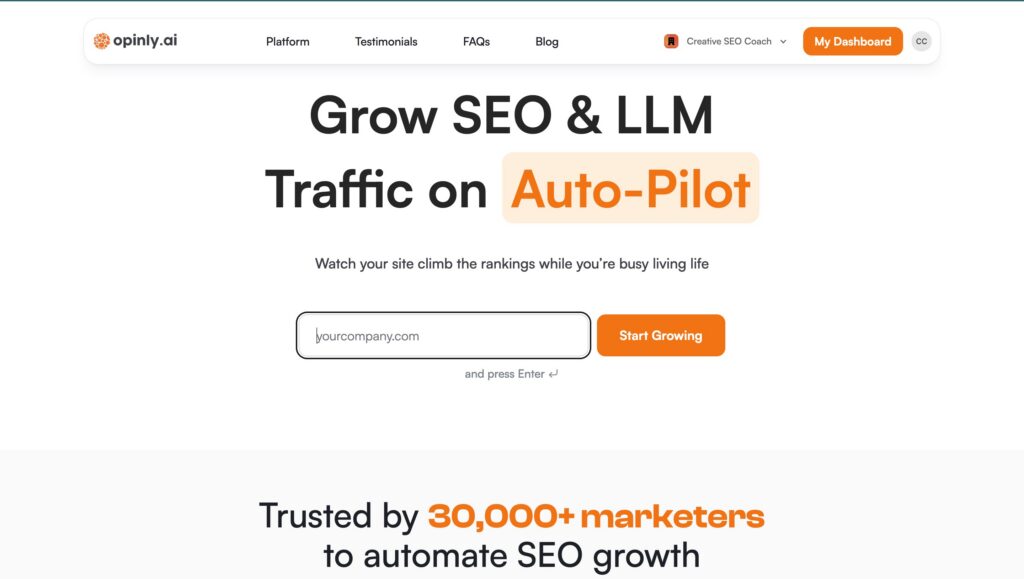
The onboarding experience is genuinely good.
Connecting a website was surprisingly easy, and I was impressed by how many platforms it supports automatically:
- WordPress
- Shopify
- Wix
- Framer
- CMS integrations
- Manual copy-and-paste publishing
The interface is clean and simple. Nothing felt overly technical.
One thing I didn’t love though?
The pricing is strangely hidden.
You pretty much have to go through the setup process before you properly see pricing, which always feels a little sneaky to me. There is a 3-day free trial available though, which is what I tested.

Opinly Pricing
At the time of testing, the monthly pricing was:
Personal — $44/month
Includes:
- 20+ backlinks per month
- 3 competitors
- solo SEO essentials
Business — $89/month
Includes:
- 60+ backlinks per month
- 8 competitors
- API access
- team collaboration
Agency — $277/month
Includes:
- 200+ backlinks per month
- 20 competitors
- white-label SEO
- SSO access
There are also yearly billing options available.

Opinly AI Features
After spending time inside Opinly, my overall feeling is that it sits somewhere in the middle.
At its core, Opinly is really:
an AI blogging and backlink automation platform with some SEO tools built around it.
The platform includes:
- AI blog generation
- keyword tracking
- competitor analysis
- site audits
- backlink exchanges
- traffic tracking
- automated publishing
The interface is simple and easy to use, which I think is part of why people will like it. It doesn’t feel overly technical or intimidating compared to a lot of SEO software.
But at the same time, once you get deeper into the platform, a lot of the features feel lighter than they first appear.
Website Integrations
The onboarding process was well done and easy to get started. It can alsoi connect with a lot of different CMS platforms plus you can smooth.
You can connect:
- WordPress
- Shopify
- Wix
- Framer
- Webflow
- NextJS
- Nuxt
- Svelte
- or publish manually yourself
The WordPress integration especially was very easy to set up.
AI Content Studio
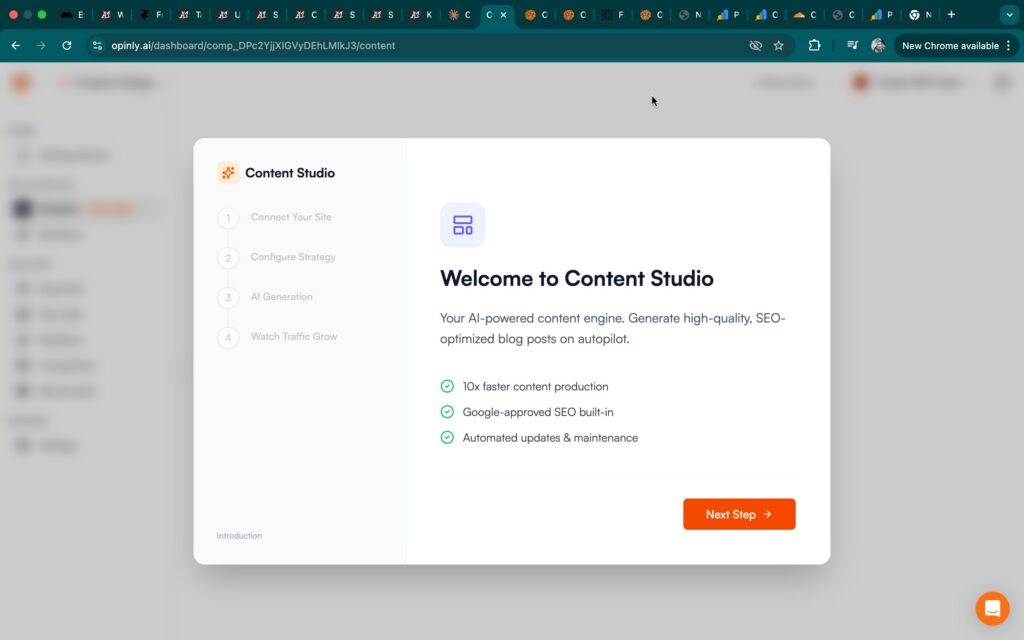
The Content Studio is really the core of the product.
This is where you:
- create keyword clusters
- generate blog topics
- write AI blog posts
- schedule publishing
- approve content
- connect directly to WordPress
Opinly positions this almost like:
“SEO on autopilot.”
The workflow itself is very simple:
- Connect your website
- Configure strategy and topics
- Generate content
- Publish automatically
I also liked that it automatically generated article hero images for blog posts.
Small detail, but genuinely useful.
The editing interface itself is clean and easy to navigate too, especially compared to some older SEO platforms.

Keyword Tracking and Research
Opinly lets you:
- track keywords manually
- monitor ranking changes
- view top-performing keywords
- discover newly ranked keywords
- search for keyword opportunities
- run competitor gap analysis
- generate content ideas
You can also filter rankings by location and see search intent and keyword difficulty.
One thing I found interesting was that the platform constantly highlights:
- newly ranked keywords
- keyword movement
- ranking improvements
I asked the customer service team where the data came from but they only confirmed that it isn’t made up.
SEO Analytics Dashboard
I liked the Opinly dashboard and how it shows you yours stats.
You can monitor:
- organic traffic
- keyword rankings
- backlinks
- domain authority
- referring domains
- ranking trends
The platform displays charts showing whether metrics are increasing or declining over time.
For example, in my dashboard I could see:
- keyword rankings declining
- traffic declining
- backlinks increasing heavily
- domain authority rising
And honestly, that combination reinforced some of my concerns about the product.
Because while backlinks and authority metrics were increasing, the actual traffic trends weren’t necessarily improving alongside them.
That’s an important distinction.
Benchmarks and Competitor Tracking
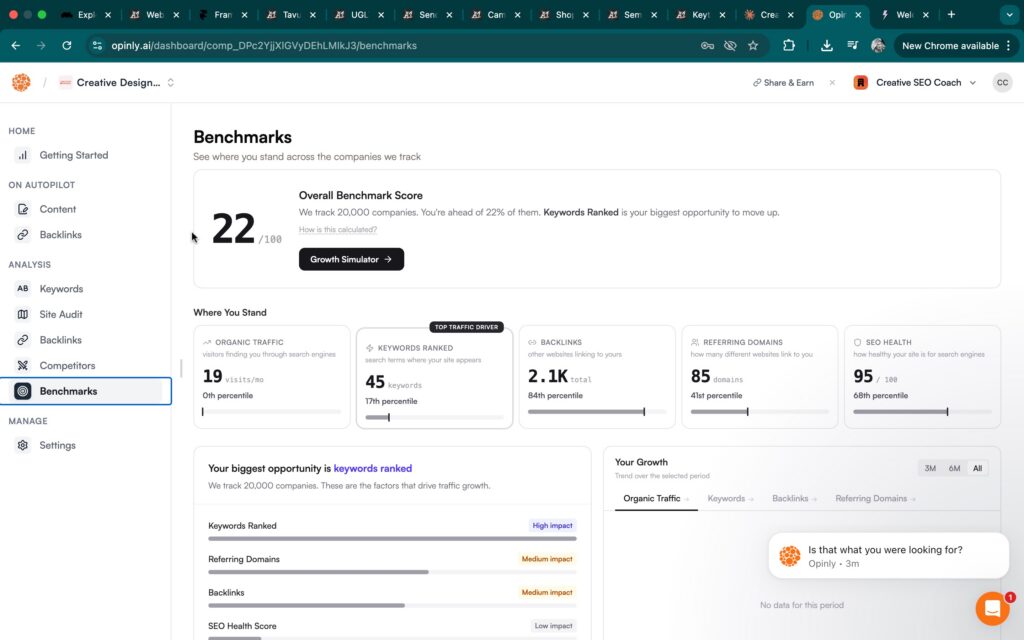
One feature I genuinely thought was interesting was the benchmarking section.
Opinly compares your website against other companies using the platform and gives you benchmark scores based on:
- keywords ranked
- backlinks
- referring domains
- SEO health
- traffic visibility
You can also track competitors and compare performance side-by-side.
I’m still undecided on how strategically useful these benchmark scores really are, but I can absolutely see why users would enjoy them.
It creates a feeling of progress and competition.
Site Audit Features
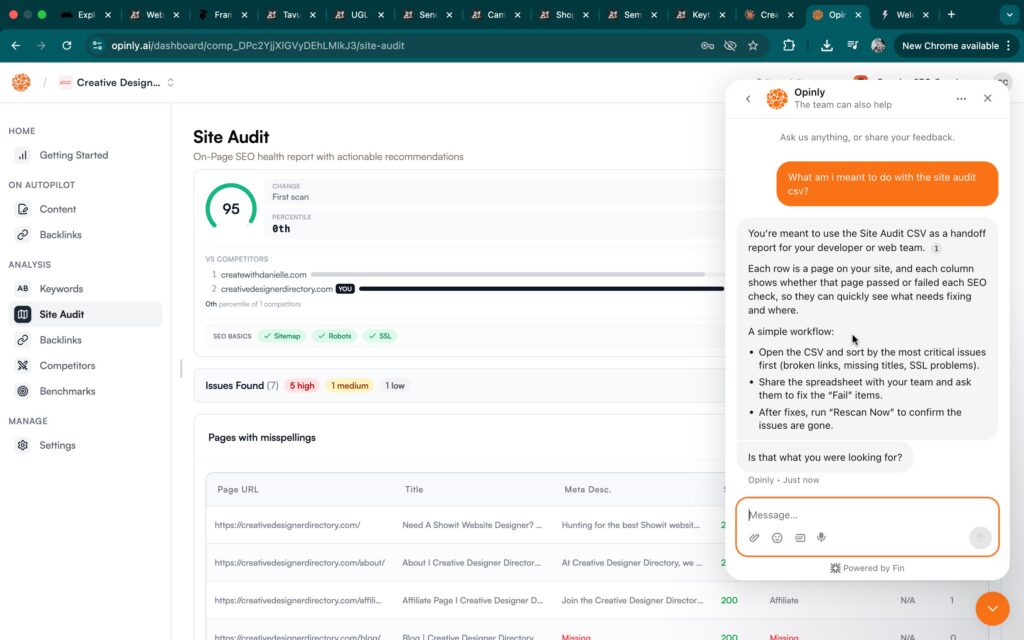
The site audit was one of the weaker parts for me.
When Opinly talks about automating SEO, I expected something a little more intelligent or guided.
Instead, the audit was feels like:
“here’s a spreadsheet of issues.”
It checks for:
- metadata
- robots.txt
- SSL
- sitemap setup
- spelling errors
- technical issues
But then it basically expects you to export the CSV file and hand it to your:
- developer
- designer
- SEO person
The misspelling checker was actually a cool idea though.
That stood out as one of the more unique audit features.

Backlink Exchange System
This is where things got fascinating.
Opinly has a built-in backlink exchange network.
Essentially:
- other Opinly users publish content
- your website gets linked naturally within those posts
- their websites get links from yours
- the platform automates the matching
The platform explains it like this:
- publish more content
- cover broader topics
- keep integrations connected
- receive more relevant backlink matches
At first, this worried me a bit.
Because historically, automated link exchanges are exactly the kind of thing Google eventually starts disliking once they become too scaled and obvious.
But then I checked one of the backlinks Opinly had already generated for me.
And honestly?
It was smarter than I expected.
The backlink came from a real Australian SEO company website. The content did contextually relate to my industry and the anchor text wasn’t overly spammy either.
The link text was:
“niche focus on creatives”
Which is actually fairly relevant to my business.
That surprised me.
Then on day two, another blog post appeared and this one was about a tool called SEO Optimizer.
And honestly?
This article would probably perform really well if I published something similar on my own directory website.
The issue is:
there’s absolutely no way I would personally recommend or promote a tool I’ve never actually used.
But because SEO Optimizer is also using Opinly, this is the type of content being generated throughout the network and it starts making more sense why some of these websites are gaining traffic.
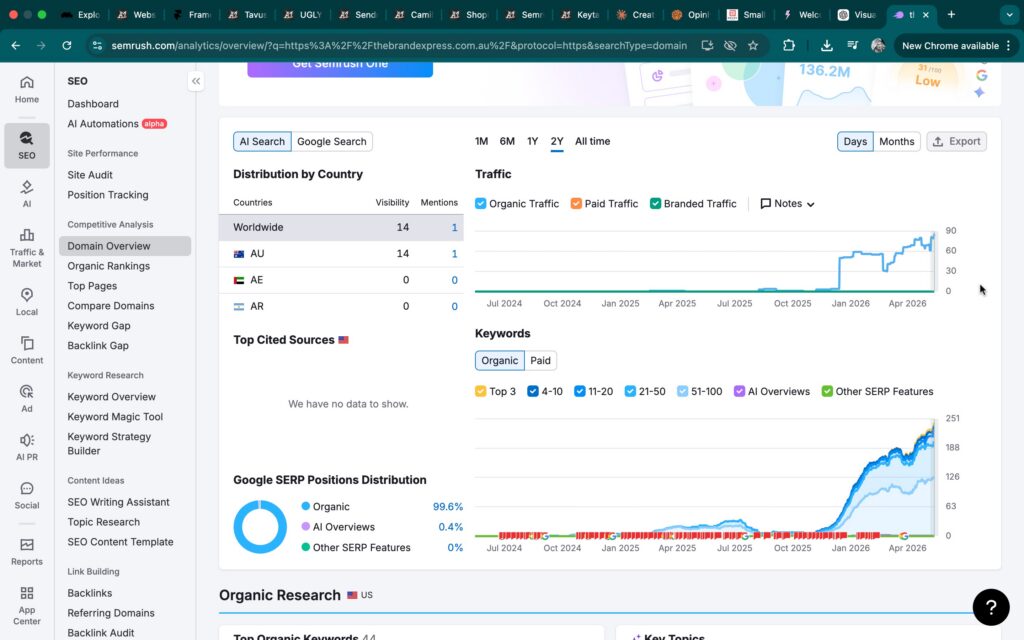
I checked SEO Optimizer in Semrush and it’s actually an older SEO tool that has been around since around 2018. It also appears to be getting solid traffic growth.
So I think the real takeaway here is less about backlinks and more about how beneficial consistent blogging still is right now.
Because even if the content isn’t incredible, publishing large amounts of reasonably relevant SEO-focused content can still move the needle.
That said, backlinks themselves have already become less important as a ranking factor over time.
Google and AI systems are getting much better at understanding:
- brand reputation
- expertise
- user engagement
- topical authority
- genuine usefulness
And personally, I suspect that once Google and AI systems properly address scaled AI-generated “SEO slop,” systems like this could eventually backfire.
Especially if too many people start publishing:
- generic AI articles
- low-quality recommendations
- content without expertise
- automated backlink-heavy posts
The safer long-term approach is probably:
using AI to help create content while still keeping strong human involvement throughout the process.
Because AI can absolutely help speed up:
- brainstorming
- outlines
- first drafts
- content structure
- research assistance
But the best content still usually comes from humans:
- refining the strategy
- improving the writing
- adding expertise
- adding original thoughts
- fact-checking
- and making sure the content is genuinely useful.
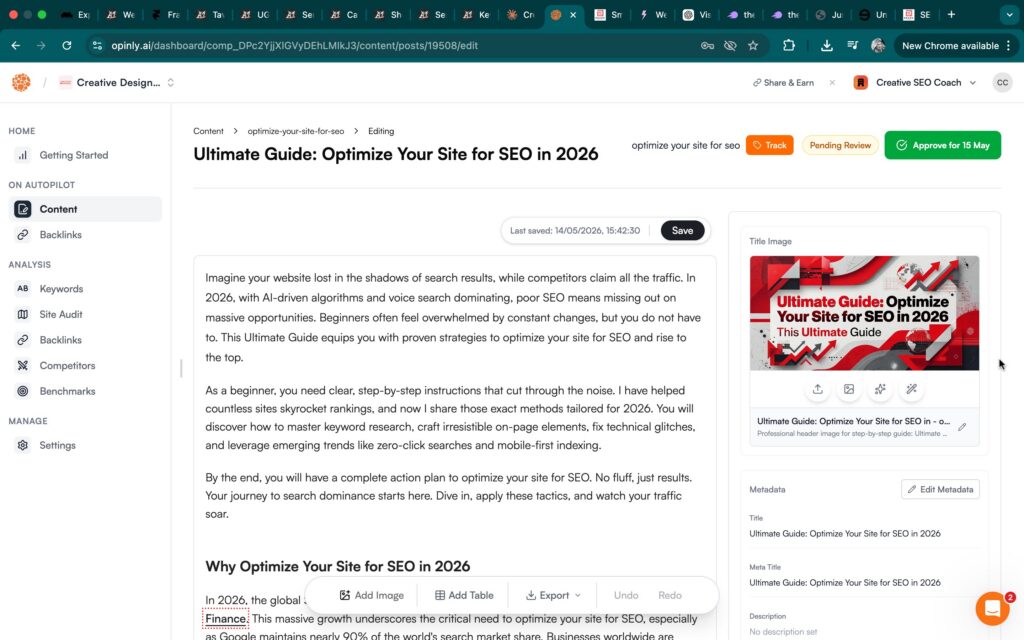
But Then I Read the Article…
And this is where my SEO brain started twitching.
The article itself felt extremely AI-generated.
No images.
Very generic structure.
Slightly awkward phrasing.
Surface-level information.
No strong opinions or expertise.
It looked like content nobody had properly reviewed before publishing.
The more I read it, the more obvious it became:
this was likely generated and published automatically with minimal human oversight. While it was good it wasn’t great. I see blog posts like this on the internet and think great it’s not going to be hard to beat this.
And that’s where I think the danger is.
The Big Problem With AI SEO Automation
Here’s the thing.
This kind of system absolutely can work in the short term.
And honestly?
It already is working for some people.
I checked the traffic of two websites using Opinly inside Semrush and both appeared to be gaining visibility and traffic.
That’s important to acknowledge.
Because people love to immediately dismiss AI SEO tools, but the reality is:
Google often rewards scalable systems temporarily before adapting later.
We’ve seen this exact pattern happen repeatedly throughout SEO history:
- private blog networks
- mass guest posting
- keyword stuffing
- AI spun content
- parasite SEO
- expired domains
Humans find a loophole.
It works.
Everyone copies it.
Then Google catches up.
And honestly, I think AI-generated backlink exchange systems could eventually follow the exact same path.
Because at the end of the day, this is trying to game the system a little bit.
You’re creating large amounts of AI-generated content and distributing backlinks across a network of websites automatically. Even if the links are contextually relevant, the overall system still feels engineered rather than naturally earned.
That doesn’t mean it won’t work right now.
In fact, I think it probably does work right now.
But SEO history is full of strategies that worked brilliantly… until they didn’t.
The concern I’d have long term is whether these backlink exchanges eventually become detectable patterns.
Because once something becomes heavily systemised across thousands of websites, it stops looking natural.
And Google has become increasingly good at identifying:
- link networks
- unnatural patterns
- low-quality AI content
- scaled automation tactics
The difficult part is that when these systems eventually get caught or devalued, the correction usually comes hard.
It’s:
great, great, great, great… then suddenly traffic drops and everyone panics.
That’s why I’d personally be cautious recommending something like this fully hands-off to clients.
Because if someone spends a year publishing hundreds of low-quality AI-generated articles through an automated system, what happens if Google later identifies those patterns?
That’s the risk.
And more importantly, there’s already research beginning to show that human-guided content still performs better long term.
According to NP Digital’s AI vs Human Content study, which analysed 744 articles across 68 websites, human-written content significantly outperformed AI-generated content over a five-month period.
The study found that human-created content steadily gained traffic over time, while the AI-generated content fluctuated much more heavily and underperformed overall.
That doesn’t mean AI content can’t work.
I actually think AI can be incredibly useful for:
- outlines
- brainstorming
- speeding up drafts
- content structuring
- research assistance
But I do think this reinforces the idea that:
human oversight still matters heavily when creating SEO content.
Because while software like Opinly may absolutely produce short-term gains, there will always be businesses:
- putting in more effort
- creating more original content
- adding genuine expertise
- improving articles manually
- building stronger brands
…and long term, those businesses will probably produce better and more sustainable SEO results.
AI Content Isn’t the Problem
What’s interesting is that I don’t think AI content itself is bad.
Actually, I think AI + human editing can produce genuinely excellent content.
Some of the best workflows now involve:
- AI helping structure ideas
- AI speeding up first drafts
- humans adding expertise
- humans adding stories, opinions, examples, and strategy
That combination can be incredibly powerful.
But fully automating everything?
That’s where quality usually starts falling apart.
And honestly, after looking through some of the content generated through Opinly’s network, I do think a lot of users are probably just hitting “publish” without properly reviewing anything.
That’s when you start getting:
- bland articles
- repetitive phrasing
- no originality
- no real expertise
- no images
- no personality
- content written for algorithms rather than humans
And eventually, search engines tend to catch up to that.
What Opinly Really Is
After testing it thoroughly, I’d describe Opinly as:
an automated AI blogging and backlink exchange platform with some SEO tooling attached around it.
The real focus is content automation.
You create keyword clusters and topic groups, then Opinly generates and publishes blog posts automatically.
You can connect WordPress directly, which I did, and publishing was relatively straightforward.
Would I Recommend Opinly?
I think you’ll see better long term results by avoiding tools like Opinly and focusing on high quality SEO instead. Will that require more time and investment? Yes. But in my experience, it’s far more sustainable.
Tools like Opinly may produce results for a while, but they can also backfire. If you’re going to use it, I’d treat it as a content assistant rather than a complete SEO solution.
Personally:
- For site audits, I’d use dedicated SEO tools that provide deeper analysis.
- For content creation, I’d rather use AI manually with human oversight and editing.
- For backlinks, I’d focus on building genuine authority and relationships instead of automation.
The reality is that even with Opinly, you’ll still need to review, edit, improve and strategically guide the output if you want the content to perform well.
And if you’re already doing all of that work yourself, you may find that you don’t necessarily need the platform in the first place.
If you use Showit specifically, I’d recommend focusing on solid on-page SEO and building a consistent blogging system with Fasta Blogging instead. In my opinion, that approach is more likely to deliver stronger long term growth and lasting search visibility.


